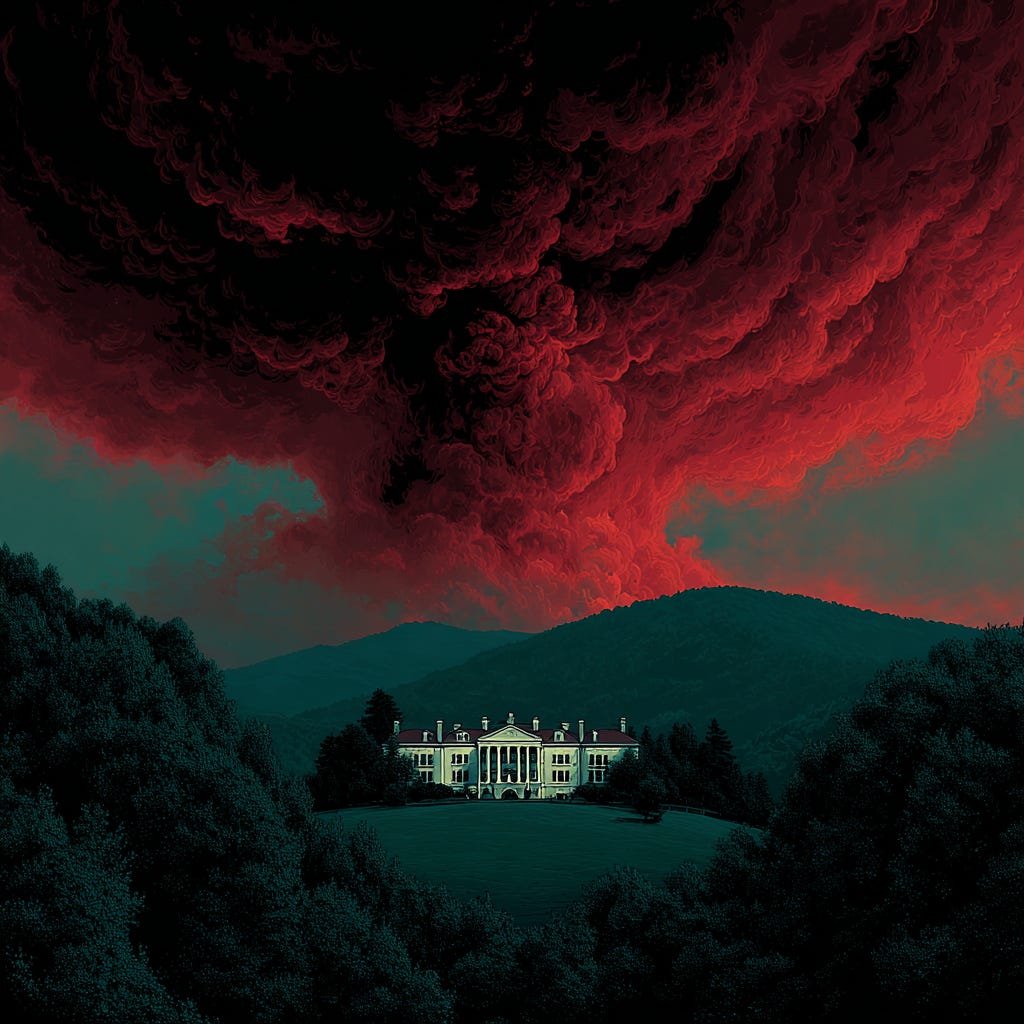
The arrogance of government has a street address. Below a luxury resort in White Sulphur Springs, West Virginia, it sits tucked behind velvet drapes and polished stonework, humming quietly in the dark. During the Cold War, the federal government carved out a full-scale underground shelter beneath the Greenbrier resort and stocked it, staffed it, and kept it ready. The bunker was never meant to save the public. When the bombs started falling, when city people turned to vapor and suburbanites turned to ash, Congress would be sealed away underground, safe and functional, debating legislation into microphones while the fallout settled across the mountains above them.
Everyday Americans would be out there burning. Succumbing to radiation sickness, to the diseases that follow the collapse of water and sanitation and food supply, to all the ordinary horrors that trail behind annihilation. Meanwhile, the people who authorized the weapons, signed the treaties, and rattled the sabers would be preserved in a climate-controlled room, ready to govern a country that no longer existed. The machinery of governance would survive even if the governed did not. Funny how Congress can barely function on a calm Tuesday, but planned to operate just fine at the end of the world.
Appalachia once again serving as the quiet buffer between power and consequence. The region has always been remote enough to be secure, stable enough to be ignored, and close enough to matter only when someone powerful needed something. The bunker’s location had nothing to do with the safety of the surrounding population. It had everything to do with distance from accountability. If the world ended, the people making the decisions would make them far from the damage they helped cause.
The bunker was never used, and that fact gets treated as a relief, even a kind of success. But an unused thing can still reveal plenty about the people who built it. The existence of the Greenbrier Bunker shows a willingness to plan for survival without reckoning, to assume that governance could continue stripped of context, consequence, and community. What would Congress have governed from down there? Ash and wasteland. Survivors who were never given a seat at the table, never offered a spot on the list, never considered part of the plan at all.
When the bunker was exposed in the 1990s, the story got repackaged as a curiosity. A museum piece. A Cold War relic worth a guided tour and some polite fascination. The existential dread got sanded down into trivia, into something you could put on a souvenir coffee mug. But the weight of the place did not go anywhere.
The Greenbrier Bunker is not a monument to fear. It is a monument to hierarchy. It answers, plainly and in concrete, the question of who was expected to endure and who was expected to disappear. It reveals that survival, at least in the planning stages, was never meant to be shared equally. Appalachia held that secret quietly for decades, the way it holds most things, without much choice in the matter. The mountains absorbed another burden they never asked for, the contingency plan for annihilation. If the unthinkable had happened, history would have continued underground, recorded by people who never heard a single scream from above.
The bunker is sealed now. Decommissioned. Declared safe and irrelevant.
But it stands as evidence that when this country stared down extinction, the plan was never to save each other. The plan was to save the paperwork.
The Greenbrier
101 W Main St, White Sulphur Springs, WV 24986


