The Michigan Dogman
Tracing a modern legend from Michigan timberlands to the hollers of Appalachia
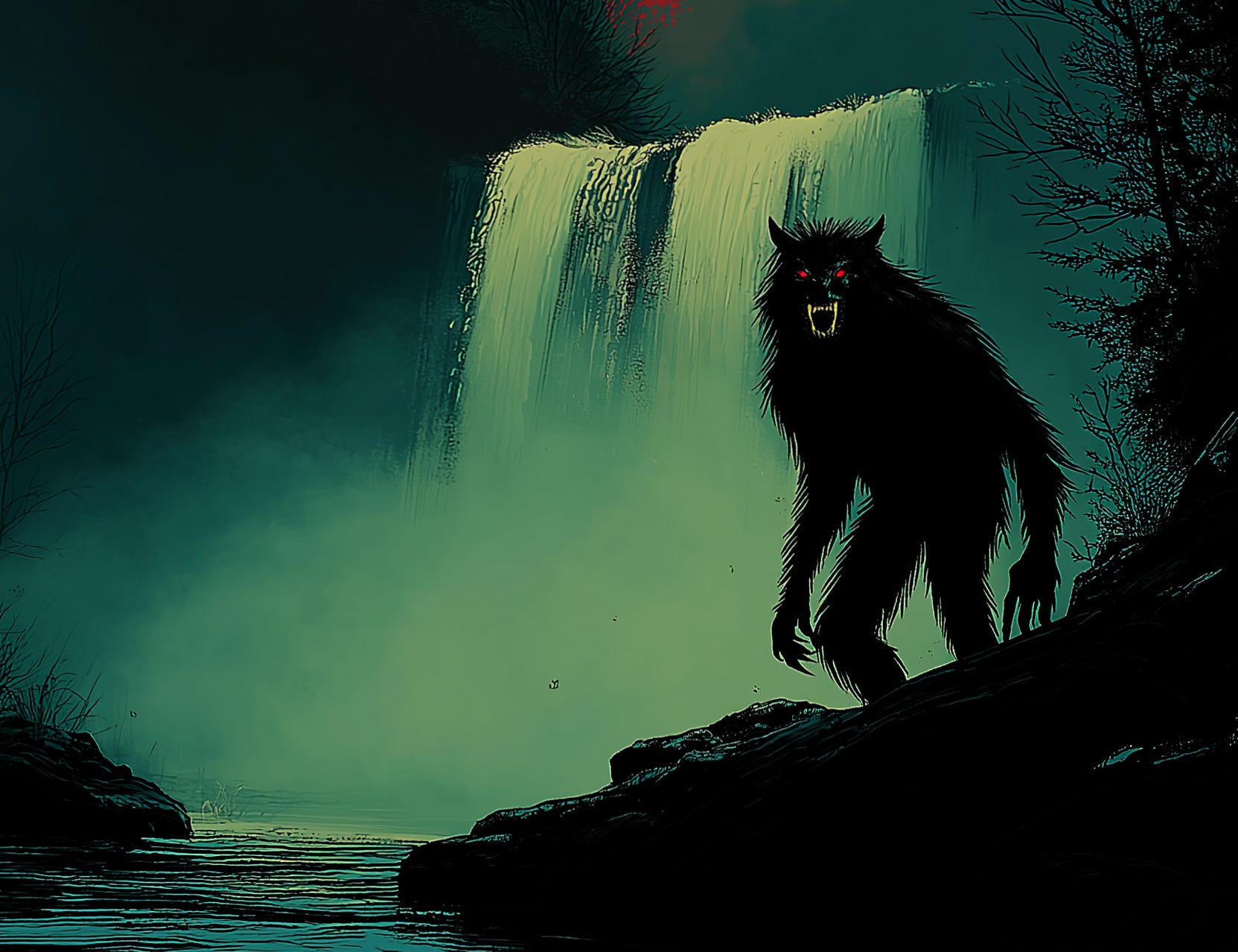
In 1887, two lumberjacks working along the Manistee River reported seeing something that did not fit into the natural order of the woods. They described a creature with the body of a man and the head of a dog. It stood upright, watching them, before retreating into the timber.
The account survives in fragments, passed down more through local retellings than formal documentation. The earliest pieces of Dogman lore come from working men, isolated places, and stories told just enough times to persist.
Half a century later, in 1937, a man named Robert Fortney claimed he was attacked outside Paris, Michigan by a pack of wild dogs. According to later accounts, one of the animals stood upright during the encounter and attempted to grab him with something described as grasping, almost human hands.
One of the most controversial elements in Dogman lore is the so-called Gable Film, allegedly shot in the 1970s near Luther, Michigan. The footage is said to depict a large, upright canine creature moving through dense brush. At one point, it pauses and looks directly toward the camera.
The film has never been publicly verified.
Some claim it was confiscated. Others argue it never existed at all. A persistent minority insist they have seen fragments of it, often describing the same sequence of movements and the same unsettling moment of eye contact.
Whether the film is real is almost secondary to what it represents. It marks the point where the Dogman shifts from regional folklore into something that feels closer to modern myth.
In 1987, Steve Cook, a radio DJ based in Cadillac, Michigan, recorded a novelty song titled The Legend. It aired on April Fool’s Day and was intended as a local joke.
Instead, it triggered a wave of calls from listeners claiming they had already encountered the creature. The broadcast did not introduce the idea so much as give it a common name and a shared shape. What had been isolated, private experiences suddenly became part of a collective narrative.
From that point forward, the Dogman was no longer just a story told in certain counties. It became a recognized figure within American cryptid folklore.
While Michigan remains the center of the legend, reports extend far beyond it. The Appalachian region, particularly Ohio, Pennsylvania, and West Virginia, holds its own quiet catalogue of encounters.
These accounts are less formal, less publicized, and often deliberately withheld. They exist in conversations rather than publications. Hunters who refuse to return to specific areas. Campers who leave before sunrise without explanation. Locals who will acknowledge something is wrong in certain stretches of land but offer no further detail.
Sightings most often occur near forest edges, rivers, and old logging paths: the places where human activity has cut into the wilderness but not fully replaced it. Witnesses frequently report a sense of being watched before seeing anything at all.
When the creature does move, it does so with speed that seems disproportionate to its size. Accounts describe a gait that shifts between human and animal, never fully settling into either.
Vocalizations are another recurring element. Growls and howls are common, but some witnesses describe something more ambiguous. Sounds that feel imitative rather than natural, as if the creature is attempting to replicate something it has heard.
Perhaps the most consistent element across all accounts is not violence, but fear. Encounters rarely end in physical harm. Instead, witnesses describe an overwhelming sense of dread, followed by a retreat, either by the creature or the observer.
It occupies a particular space in the American imagination: the edge of the woods, where the known world ends and something older, or perhaps simply unrecognized, begins.
Whatever the explanation, misidentification, folklore, or something not yet understood, the consistency of the accounts ensures one thing:
The Dogman is not going away.