Point Pleasant, West Virginia
The story of the Mothman doesn’t begin with folklore, but a police report.
It was 11:30 p.m. on November 15, 1966, when Roger was cruising his Chevrolet Bel Air with Linda, Steve, and Mary. They drove out past town, where the maze of earthen bunkers and moss-choked concrete igloos of the old TNT Area lay rotting in the dark.
That’s when they saw it.
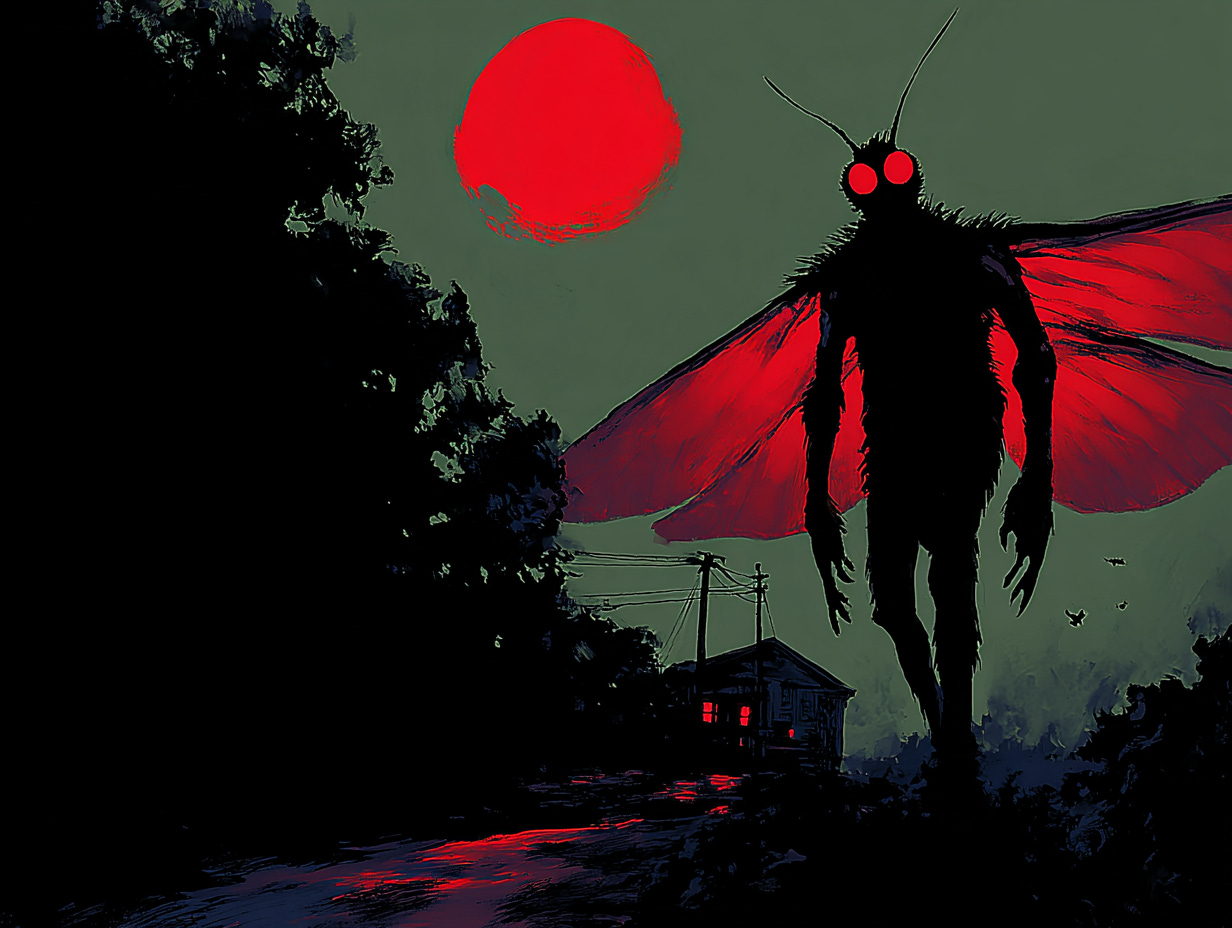
Something tall stood where nothing should’ve been. Black wings unfurled. Two red eyes burned like lit cigarettes in the night.
Roger slowed to get a better look and that hesitation got them noticed. Confused and bewildered, Roger slammed the accelerator and hurled the car down Route 62. The engine screamed. The speedometer climbed. And above them, moving with unnatural smoothness, the figure kept pace, nearly a hundred miles an hour in pitch-black air, while Roger fought the wheel.
It followed them to the edge of town, then vanished.
They tore through Point Pleasant and rushed to the sheriff’s office, piling out of the car shaking, shouting over one another, trying to explain what had chased them out of the night. The sheriff took the report seriously, later noting that all four appeared genuinely frightened and sober-minded.
That night marked the beginning of the thirteen-month period that would come to be known as the Mothman Flap.
Accounts vary, as they always do. That’s what happens when hundreds of people start seeing the same thing from different angles. But the consistency lives in what wasn’t reported.
It didn’t mutilate livestock. It didn’t leave bodies behind. Nobody vanished, as far as anyone can prove. Some reported paralysis during their encounters. Others said it left them sick with dread sitting heavy in the gut and nausea that wouldn’t pass. Others simply refused to talk about it.
Then the Silver Bridge fell.
Stress compounded over time. Metal fatigue. A single point of failure doing what single points of failure always do. Forty-six people died when the bridge dropped into the Ohio River.
And the sightings stopped.
No wings.
No eyes.
No watchers on the road.
Maybe the town was too broken with grief to keep looking at the sky. When you’re counting bodies, there’s no room left for phantasms. Or maybe the Mothman was never meant to linger. Appalachian folklore understands omens don’t cause disaster, they surface when pressure builds, when systems near collapse. The Mothman wasn’t hunting Point Pleasant. It was a signal flare fired from the dark.
What gets lost in the merchandising is how little spectacle there ever was. No prophecies. No cosmic speeches. Just a shape at the edge of vision and the feeling that something had already slipped its leash. The terror wasn’t in what it did. It was in what it seemed to know.
That’s why the legend never settles. It resurfaces now and then, near disasters, watching with the same unblinking gaze.
In Appalachia, we d
on’t ask whether the Mothman is real.
We ask what breaks next.


Great stuff.